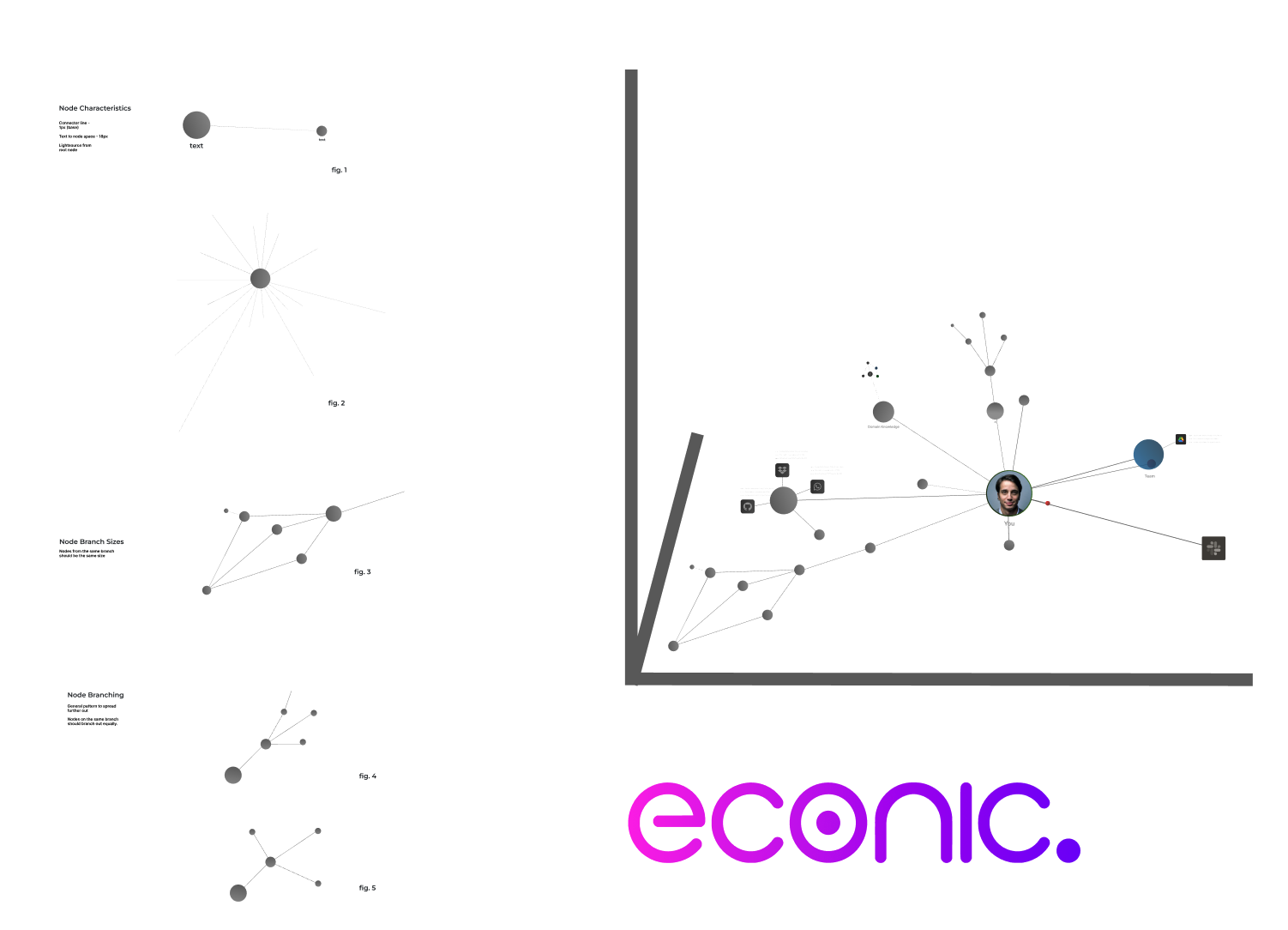
Econic is a research-first technology company building Australia's position as a global leader in AI and AGI infrastructure.
We set out to solve a fundamental problem: how to move the industry from isolated AI models to collaborative, multi-graph systems.
I participated in the visual execution and UI/UX design, focusing on the look and feel of how complex graph structures—domain knowledge, user context, and organizational ontologies—interface with the user at query time. My role was to translate abstract, multi-party intelligence into a cohesive visual language, ensuring that the collaborative framework and knowledge mapping were not just technically feasible, but felt tangible and intuitive to the end user.
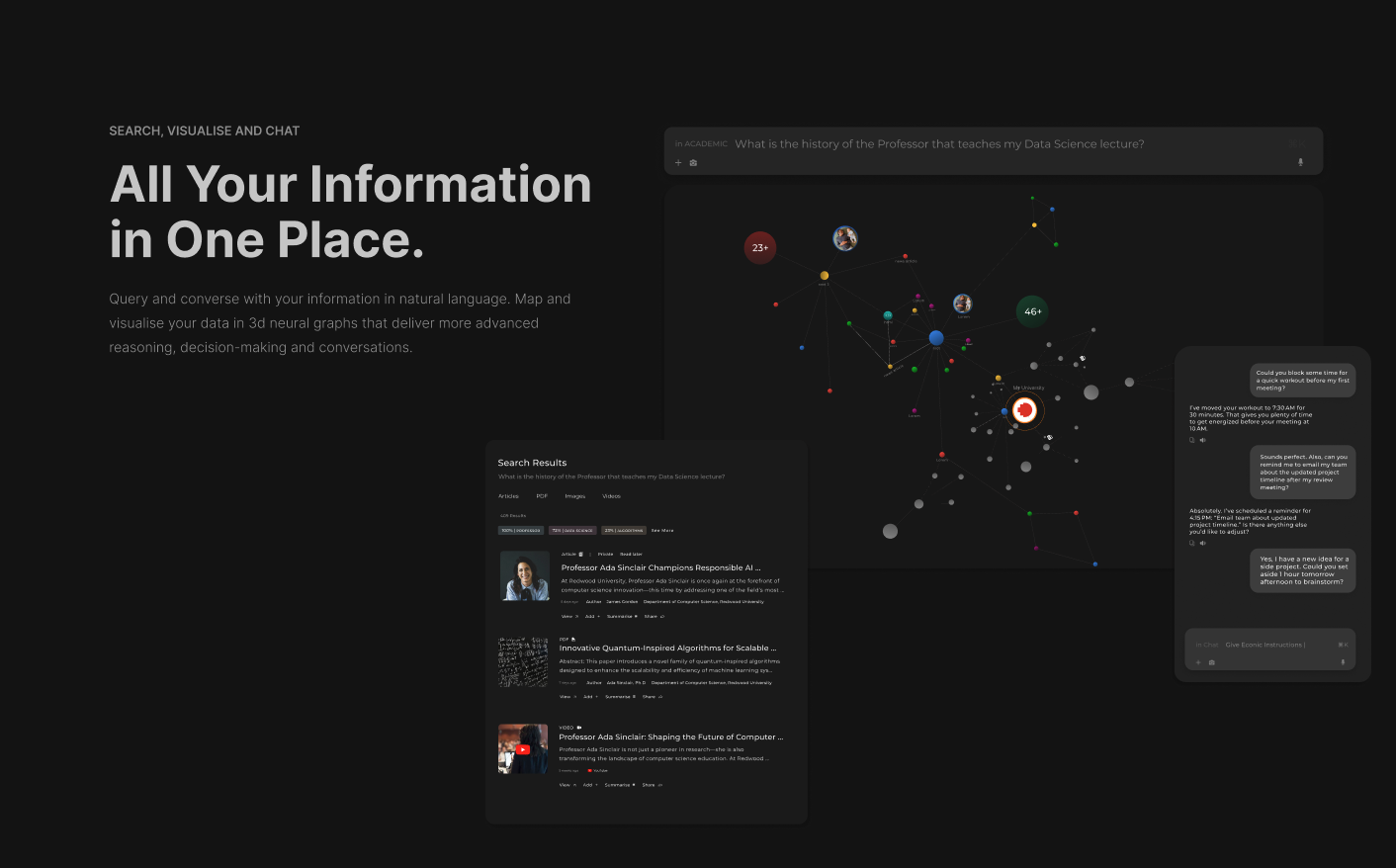
The primary hurdle in designing the Intelligence Dashboards and Feeds was the "hairball" problem of massive graph visualization. In a multi-graph system, the goal is to surface latent patterns—insights invisible in any single dataset.
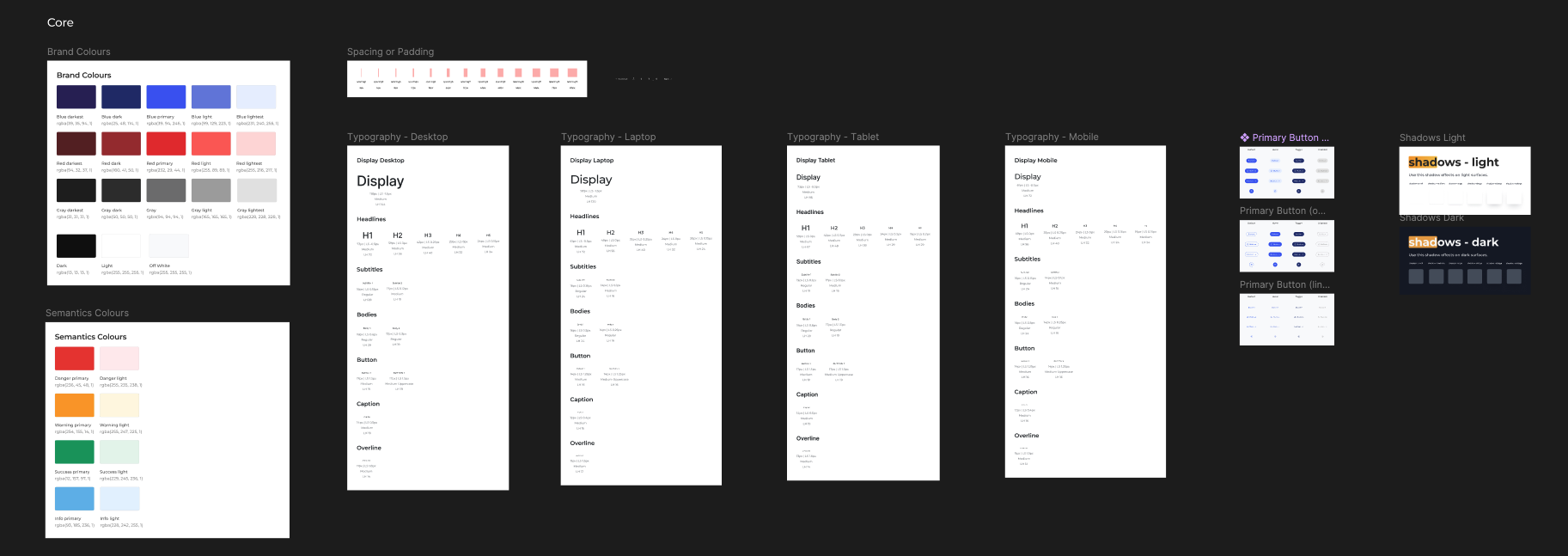
Structural Elasticity: I developed a design system that was "topology-aware," ensuring components could adapt as the underlying relationships in the model evolved.
Onboarding for Complexity: I designed Setup Wizards that would allow users to connect multiple applications to the platform.
A core part of my work was prototyping the Omni Bar and Massive Graph Search UI. We moved away from the standard search-and-results pattern toward "coordinated inference."
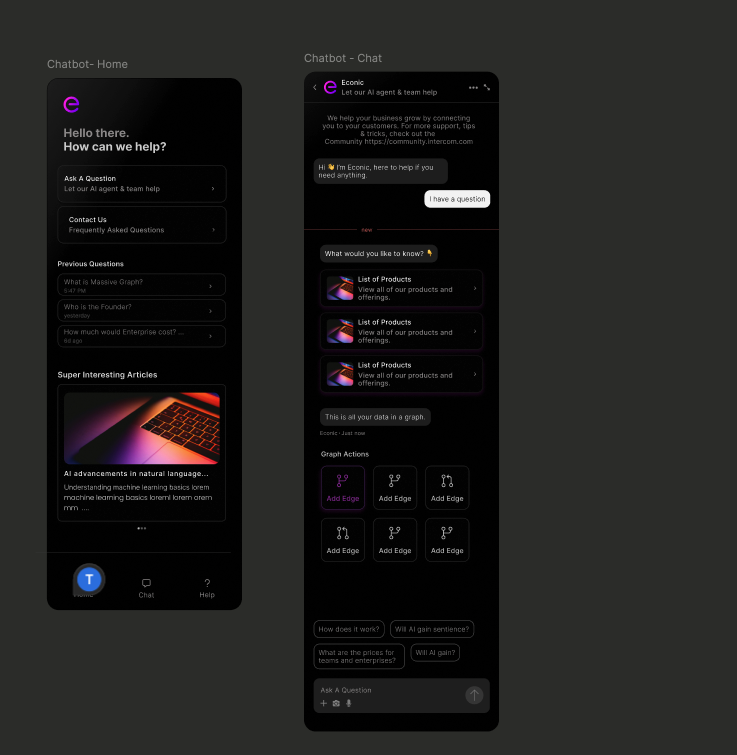
The Omni Bar: A contextual AI butler for real-time navigation and action.
The Omni Bar acts as a bridge, visually indicating which specific graphs—context, domain, or memory—are being queried in real-time. I designed this to function as an AI butler on the page, allowing users to navigate the site and ask questions directly in context to the specific content they are viewing.
Rather than just a search box, the interface was built to perform direct actions and provide deep insights regarding Econic’s research and infrastructure. By making the AI aware of the user's current page, we turned a black-box process into a transparent, highly-contextual, and actionable projection of intelligence.
The Massive Graph Search UI was designed to move beyond lexical matching. By leveraging the underlying nodes of the enterprise ontology, search results are presented as relational clusters.
Users don't just find a document; they navigate the boundaries between domain knowledge and organizational structure. Every search result is a node that reveals its own dependencies, allowing for a "walkable" search experience that surfaces information existing across disparate systems.
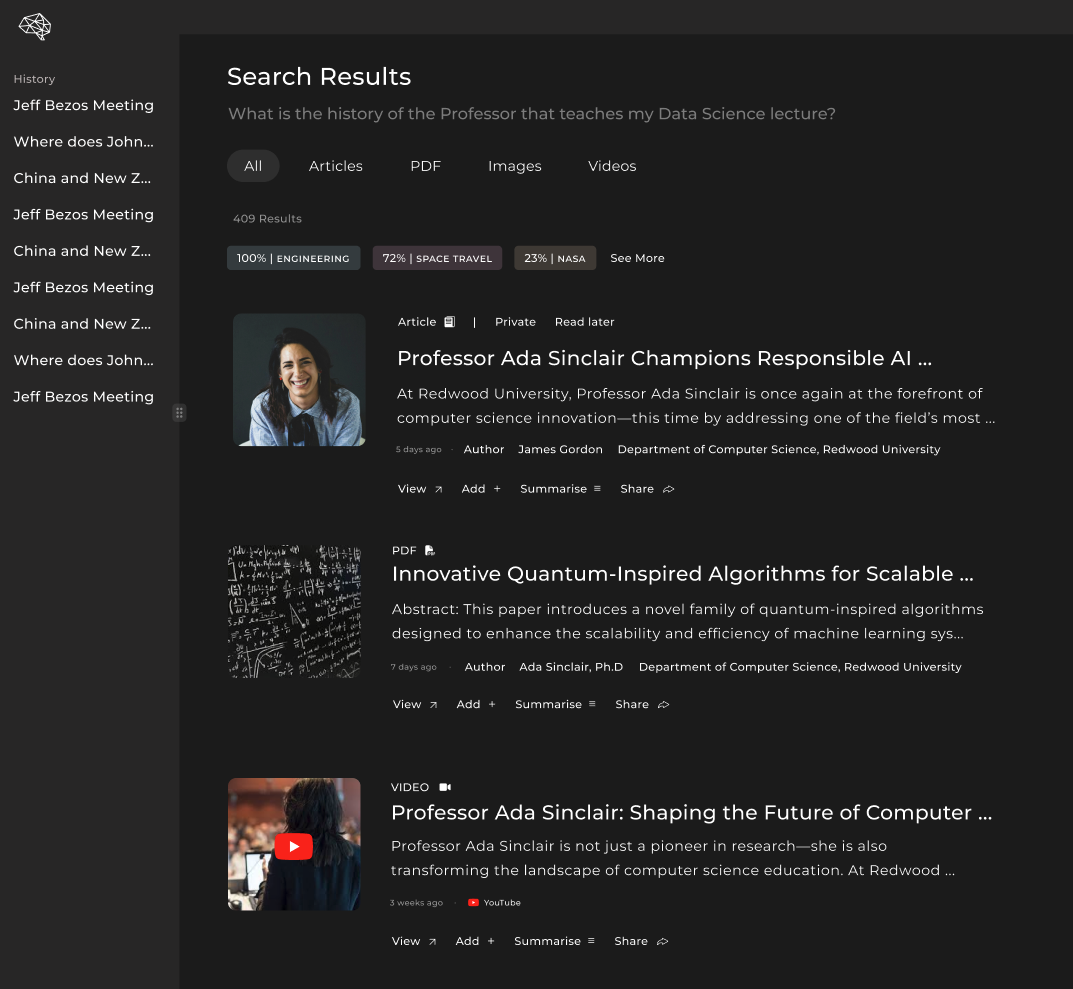
The Community Discussion UI treats collaborative interactions as live edges within the graph. Instead of static threads, discussions are modeled as Intelligence Clusters—where user contributions evolve the memory graph in real-time.
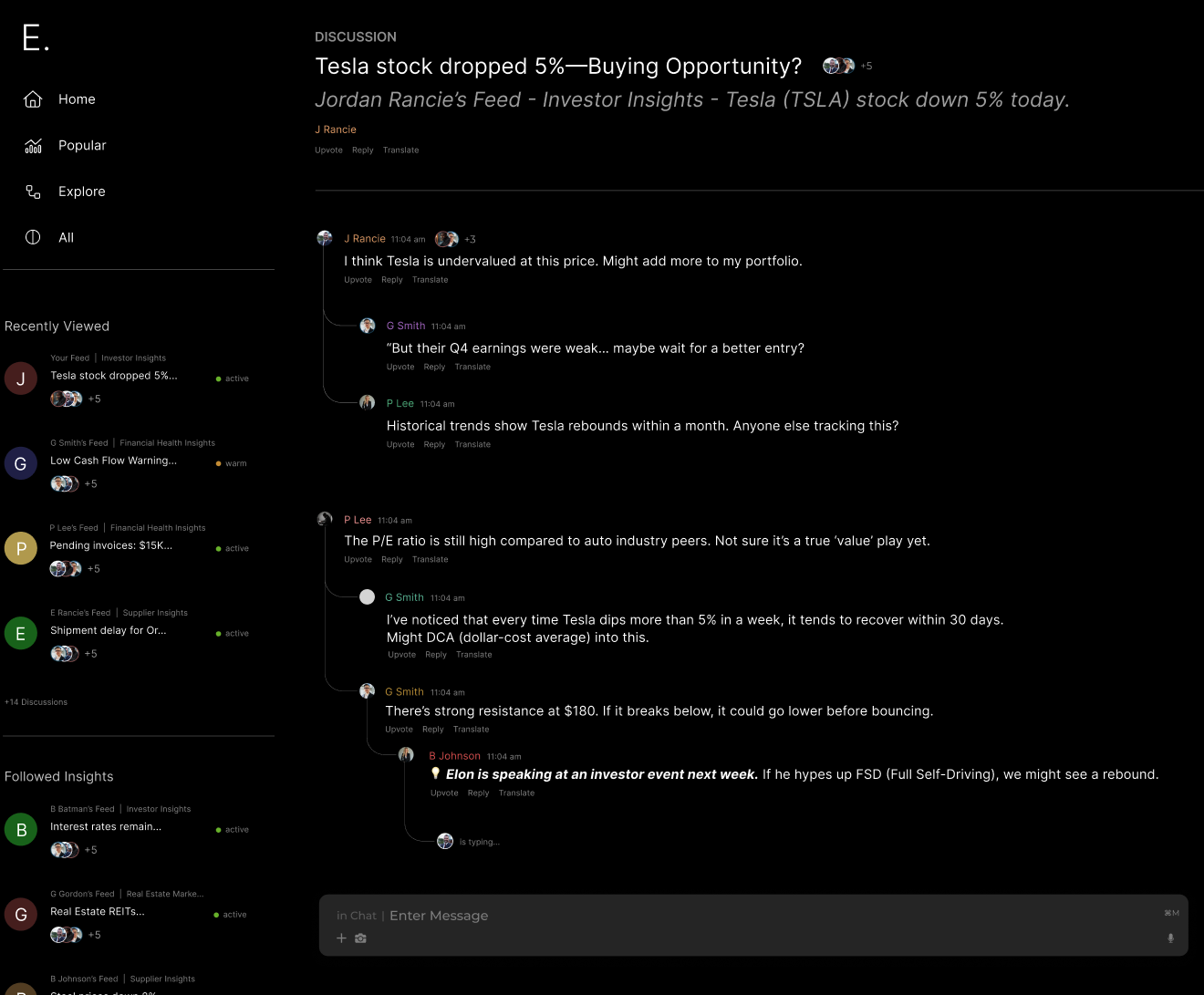
This interface was a key part of our strategy to facilitate "shared understanding." By visualizing how community discussions link back to core research nodes, we created a feedback loop where human insight directly informs and weights the AI’s relational model.
Reflecting on this journey, the biggest challenge was moving from deterministic interfaces to probabilistic ones. Successfully bridging the gap between high-level strategy and functional prototypes has redefined how I view the "interface as a projection of intelligence."
Jordan’s vision for graph-based AI provided the perfect sandbox for me to apply my background in logic and law to the world of technology. His belief in my ability to make the "jump" into tech has been a defining part of my professional growth, and I am proud of the work we have prototyped together.